The landscape of small business and startup operations is rapidly evolving, and Artificial Intelligence (AI) is no longer a technology reserved for enterprise giants. For lean teams and growing ventures, AI presents a massive opportunity to scale efficiently, reduce overhead, and drastically improve customer experience.
But where do you start?
Identifying Your AI Opportunity
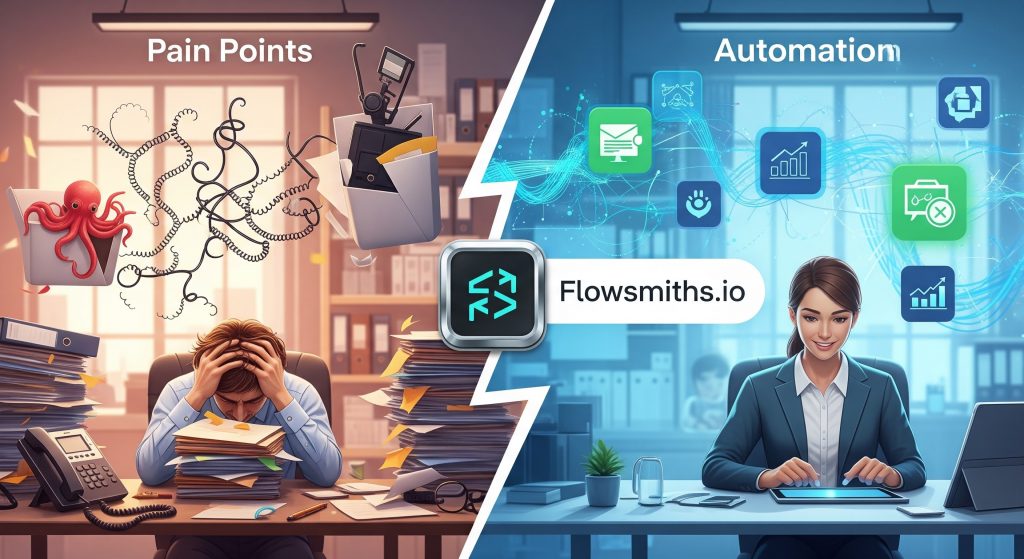
The first step to successfully integrating AI is to pinpoint the areas of your business experiencing the most friction or consuming the most time—your pain points. These are often repetitive, administrative tasks that, while essential, pull valuable human resources away from high-impact, strategic work.
This is where specialists like Flowsmiths.io business automation specialists come in. Our team helps you audit your existing workflows to clearly identify bottlenecks suitable for AI intervention. Whether it’s customer support, lead qualification, data entry, or internal communication, understanding your unique operational challenges is the foundation of a successful AI strategy.
The Most Common Starting Point: Automated Reception
Many small businesses and startups struggle with managing a high volume of inbound communication, especially phone calls. Missed calls mean lost leads and poor customer service. Hiring a full-time human receptionist can be cost-prohibitive.
Meet FlowPhone: Your Virtual Receptionist
For businesses ready to take the leap into automation, we often recommend starting with FlowPhone. FlowPhone is a state-of-the-art virtual receptionist designed to handle the core challenges of inbound call management:
- Massive Capacity: FlowPhone is capable of answering up to 10 calls simultaneously, ensuring that no potential client hears a busy signal or is left waiting indefinitely.
- Intelligent Routing: It doesn’t just answer; it listens. FlowPhone can accurately route the call to the correct department or individual based on the caller’s needs, mimicking a skilled human operator.
- Information Gathering: Before transferring, or even as a standalone service, FlowPhone can gather essential information (e.g., name, account number, reason for calling) and seamlessly log it into your CRM.
- Service Integration: Crucially, it can schedule appointments directly into your calendar, handling complex tasks that often require human intervention.
Implementing a solution like FlowPhone means your human staff can focus on fulfilling client services or closing sales, secure in the knowledge that your front-line communication is handled 24/7 with professional efficiency.
Beyond the Phone: Scaling AI Throughout Your Business
Once you’ve successfully automated your initial pain point, the pathways for further AI integration are vast:
| Area of Business | AI Implementation Focus | Key Benefits |
|---|---|---|
| Marketing | Content generation (blog drafts, ad copy), personalized email sequences. | Increased content velocity, higher conversion rates. |
| Sales | Lead scoring, CRM data enrichment, personalized follow-up prompts. | Shorter sales cycles, improved lead prioritization. |
| Operations | Inventory forecasting, supply chain optimization, automated reporting. | Reduced waste, better capital allocation, real-time insights. |
| Customer Support | Advanced chatbots, automated ticket tagging and routing, sentiment analysis. | Faster response times, reduced agent workload, proactive problem solving. |
Taking the Next Step
AI is not about replacing human talent; it is about augmenting it. By partnering with specialists who understand both the technology and the unique pressures of a small business, you can identify and implement the right solutions without overwhelming your team.
The Snowball Effect: From Automation to Optimization
A single successful AI implementation often illuminates deeper operational inefficiencies, leading to a cascade of further optimization. For instance, we recently worked with a client whose primary pain point was the immense time spent on repetitive data entry and task management within their existing Customer Relationship Management (CRM) platform, HubSpot.
Our initial solution automated these repetitive tasks, instantly freeing up several hours per employee each week. However, in the process of auditing their workflows, we made a crucial discovery: the client was paying for the full, premium suite of HubSpot features, but their actual usage only tapped into about 10% of the platform’s capabilities.
Having already automated their core needs—lead logging, task creation, and follow-up prompts—we realized the hefty monthly CRM fees had become an unnecessary overhead. By leveraging more granular, dedicated automation tools combined with a cost-effective, scaled-down database solution, we successfully replaced every essential function they required, eliminating their dependency on the high-cost, underutilized CRM.
This is the power of a phased approach: initial success in solving a core pain point opens the door to deeper business optimization, transforming an operational fix into a substantial reduction in overhead and an immediate increase in profit margin.
Ready to find out which administrative burden Flowsmiths.io can turn into an automated asset? Let us help you identify your operational pain points and develop a phased AI implementation plan tailored for startup success.